Restless Nights, Hidden Causes: What Your Dentist Sees That Your Doctor Might Miss
For many Americans, chronic fatigue has become so familiar it feels normal. Coffee in hand before 7 a.m., an afternoon slump that no amount of willpower can shake, and a morning alarm that always arrives too soon — these experiences are so common that millions simply accept them as part of modern life. But what if the root cause of your exhaustion had less to do with your schedule and more to do with what happens inside your mouth while you sleep?
The connection between oral health and sleep quality is one of the most underappreciated relationships in medicine. Dentists are increasingly positioned on the front lines of identifying sleep-related breathing disorders — not because they have replaced sleep specialists, but because the mouth offers a uniquely revealing window into the airway, jaw structure, and tissue dynamics that govern nighttime breathing.
The Anatomy of a Disrupted Night
To understand why dentists matter in this conversation, it helps to understand what physically happens during obstructive sleep apnea (OSA) and related breathing disorders. When the muscles of the throat relax during sleep, the soft tissues at the back of the mouth — including the soft palate, uvula, and tongue — can collapse inward, partially or fully blocking the airway. The brain, sensing the drop in oxygen, jolts the body awake just long enough to restore breathing. This cycle can repeat dozens or even hundreds of times per night, fragmenting sleep so severely that the person never reaches the deep, restorative stages that the body depends on.
According to the American Academy of Sleep Medicine, an estimated 30 million Americans have obstructive sleep apnea, yet the majority remain undiagnosed. The condition is strongly associated with cardiovascular disease, type 2 diabetes, depression, and cognitive decline — making early identification a genuine public health priority.
What does this have to do with your dentist? Quite a lot, as it turns out.
What a Dental Exam Reveals About Your Airway
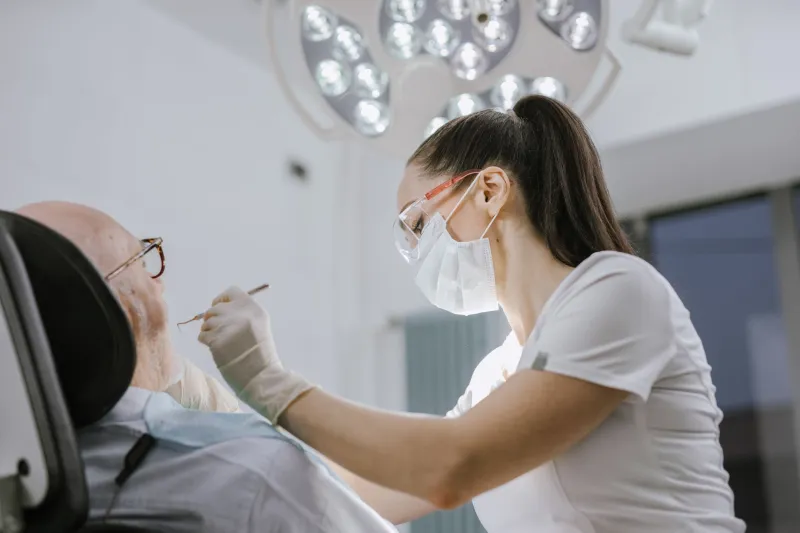
During a comprehensive oral examination, a trained dentist evaluates far more than the condition of individual teeth. The size and position of the tongue, the depth of the palate, the degree of jaw misalignment, and the volume of soft tissue at the back of the throat are all observable — and all clinically relevant to sleep-disordered breathing.
Several specific findings can prompt a dentist to raise concerns about a patient's sleep quality:
- Scalloped tongue edges, which suggest the tongue is habitually pressing against the teeth — often a sign that it is competing for limited space in the airway during sleep.
- Worn or flattened tooth surfaces, a hallmark of bruxism (teeth grinding) that frequently co-occurs with sleep apnea as the body attempts to reopen the airway by clenching the jaw.
- A high, narrow palatal arch, which correlates with a reduced nasal airway and a greater likelihood of mouth breathing at night.
- Enlarged tonsils or a low-hanging uvula, both of which can physically narrow the throat's passage.
- Retrognathia, a condition in which the lower jaw sits further back than ideal, positioning the tongue closer to the airway and increasing obstruction risk.
None of these findings alone constitutes a diagnosis of sleep apnea — that determination requires a formal sleep study. However, a dentist who identifies one or more of these markers can initiate a critically important conversation and refer patients to the appropriate specialist before years of disrupted sleep take their toll.
Oral Appliances: A Dentist-Delivered Solution
For patients who have already received a diagnosis of mild to moderate obstructive sleep apnea, or for those who cannot tolerate continuous positive airway pressure (CPAP) therapy, dentistry offers a compelling alternative: the mandibular advancement device (MAD).
This custom-fitted oral appliance resembles a sports mouthguard but functions quite differently. Worn during sleep, it gently repositions the lower jaw slightly forward, which in turn pulls the tongue and associated soft tissues away from the back of the throat. The result is a more open airway, fewer breathing interruptions, and — for many patients — a dramatically improved quality of sleep.
The American Academy of Dental Sleep Medicine endorses oral appliance therapy as a first-line treatment for mild to moderate OSA and as an alternative for patients with severe OSA who are unable to use CPAP consistently. Because the devices are custom-fabricated based on precise impressions of the patient's dentition, fit and comfort are far superior to over-the-counter alternatives, and adjustments can be made over time to optimize both efficacy and comfort.
At RAK Dental Clinic, patients who present with signs of sleep-disordered breathing are evaluated thoroughly before any appliance is recommended. Collaboration with sleep medicine physicians ensures that every treatment decision is grounded in a complete clinical picture.
When Alignment Is the Underlying Issue
Jaw misalignment — whether due to skeletal structure, prior tooth loss, or a history of poorly fitted restorations — can contribute meaningfully to nighttime breathing difficulties. When the bite is misaligned, the jaw may habitually rest in a position that crowds the airway. Addressing the underlying occlusal issue, through orthodontics, restorative work, or in some cases oral surgery, can produce improvements in airway patency that no appliance alone would achieve.
This is one reason why comprehensive dental care, rather than isolated treatment of individual symptoms, tends to yield the most durable outcomes. A dentist who evaluates the mouth as an integrated system — not merely a collection of teeth — is better positioned to identify the structural contributors to sleep disruption.
Life on the Other Side: What Patients Experience
Consider the experience of a patient in her mid-forties who had spent nearly a decade attributing her fatigue to the demands of raising a family and managing a career. Her dentist, during a routine checkup, noted significant wear on her posterior teeth, a scalloped tongue, and a moderately narrow palate. She was referred for a sleep study, which confirmed moderate obstructive sleep apnea. Following a period of CPAP therapy and a subsequent transition to a custom oral appliance, she described the change as transformative — not just in energy levels, but in mood, concentration, and her relationship with her partner, who had been losing sleep to her snoring for years.
Stories like hers are not unusual in dental sleep medicine. The common thread is that the problem had been present for years, hiding in plain sight, until a dentist looked beyond the teeth and asked the right questions.
What You Can Do Now
If you regularly wake feeling unrefreshed, if your partner reports that you snore or stop breathing during the night, or if you find yourself grinding your teeth, these are signals worth discussing at your next dental appointment. A few targeted questions and a thorough clinical examination may be all it takes to set a path toward better rest in motion.
Preventing the long-term health consequences of untreated sleep apnea — and reclaiming the energy that comes with genuine, restorative sleep — begins with the kind of comprehensive, attentive care that looks at the whole patient, not just the individual tooth. That is precisely the standard of care that defines what a modern dental practice can and should offer.
Your dentist may not be the first professional you think of when sleep trouble arises. After a thorough examination, however, they may well be the most important one you consult.