How Digital Impressions and 3D Imaging Are Redefining the Dental Visit
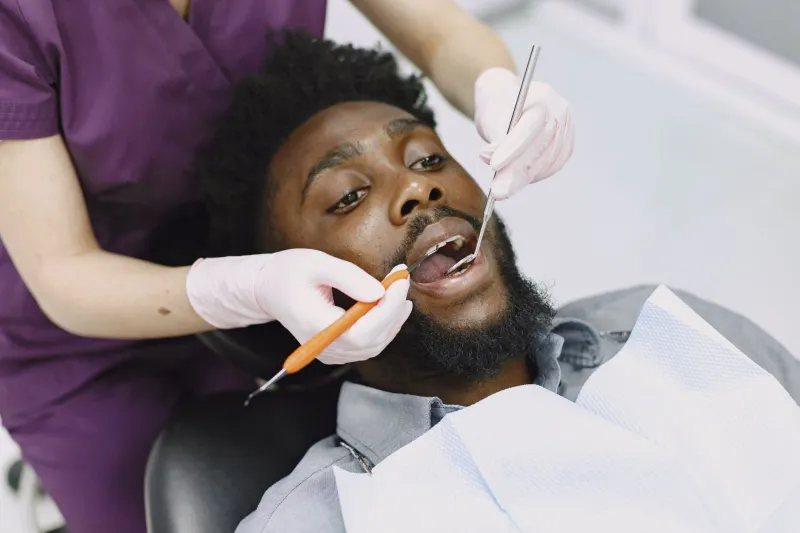
For many Americans, the memory of a dental impression involves a tray filled with thick, goopy material pressed against the teeth and held in place for what felt like an eternity. It was effective, but far from pleasant — and for patients with a strong gag reflex, it was genuinely distressing. That experience, once considered an unavoidable part of dental care, is rapidly becoming a relic of the past.
A new generation of digital tools has arrived in dental practices across the country, and the changes are not merely cosmetic. From the moment a patient opens their mouth for an examination to the moment a final restoration is seated, technology is improving every step of the process. At RAK Dental Clinic, staying current with these advancements is not a luxury — it is a commitment to delivering the highest standard of care.
The Shift from Physical to Digital Impressions
Traditional impression materials served dentistry well for decades, but they came with meaningful limitations. Dimensional distortion during setting, the need for careful storage and rapid transport to a laboratory, and patient discomfort were all accepted as part of the process.
Digital intraoral scanners have changed that equation entirely. These handheld wand-like devices capture thousands of images per second as they are gently moved around the mouth, assembling them in real time into a precise three-dimensional digital model of the teeth and surrounding tissue. The entire process typically takes only a few minutes, produces no mess, and is comfortable even for patients who have historically struggled with traditional impressions.
The accuracy of digital scans has also proven highly competitive with conventional impressions. Research published in dental literature consistently demonstrates that intraoral scanners produce models with margins of error measured in microns — a level of precision that translates directly into better-fitting crowns, aligners, bridges, and other restorations. Fewer remakes, fewer adjustments, and fewer return visits are the practical result for patients.
Cone Beam CT: Seeing the Whole Picture
Conventional two-dimensional dental X-rays remain a valuable diagnostic tool, but they have an inherent limitation: they flatten a three-dimensional structure into a single plane. Overlapping anatomy can obscure important details, and the depth relationships between structures are lost entirely.
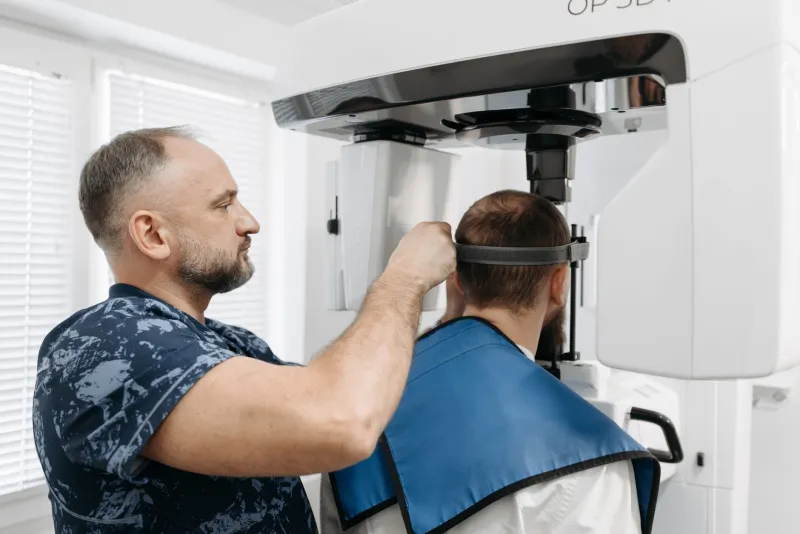
Cone beam computed tomography — commonly referred to as CBCT or cone beam CT — addresses this limitation by capturing a full three-dimensional image of the teeth, jawbone, nerve pathways, and surrounding structures in a single low-dose scan. The resulting image can be rotated, sectioned, and examined from any angle, giving clinicians an unprecedented view of what lies beneath the surface.
The applications are wide-ranging. For patients being evaluated for dental implants, CBCT imaging allows the treating team to measure bone volume and density with precision, identify the exact location of the inferior alveolar nerve, and plan the surgical placement of the implant down to the millimeter — all before a single incision is made. For patients presenting with unexplained pain, the three-dimensional view can reveal hairline fractures, root abnormalities, or early signs of pathology that a standard X-ray might miss entirely.
For patients, the practical benefits are significant: more accurate diagnoses, fewer surprises during treatment, and a higher degree of confidence that the proposed treatment plan is grounded in complete information.
Computer-Aided Design and Manufacturing in the Dental Office
The integration of computer-aided design and manufacturing — known in dentistry as CAD/CAM technology — has brought another remarkable capability to forward-thinking practices: the ability to design and fabricate certain restorations in a single appointment.
Using a digital scan as the foundation, software allows a dental team to design a crown, inlay, onlay, or veneer on screen, adjusting the shape, contact points, and occlusion with precision. That design is then transmitted to an in-office milling unit, which carves the restoration from a block of high-quality ceramic in a matter of minutes.
The implications for patients are considerable. A procedure that once required two appointments — one to prepare the tooth and take an impression, and a second weeks later to seat the finished restoration — can now be completed in a single visit. There is no temporary crown to manage, no second injection of anesthetic, and no waiting period during which the temporary may become dislodged or uncomfortable.
The quality of same-day restorations has also improved significantly as both the software and the milling materials have matured. Modern dental ceramics used in CAD/CAM systems are engineered for strength and longevity, and the color-matching capabilities allow restorations to blend seamlessly with surrounding natural teeth.
Digital Treatment Planning: Showing Patients Their Future Smile
Perhaps one of the most underappreciated benefits of digital technology in dentistry is the improvement it brings to patient communication and education. When a treatment plan involves multiple steps or significant changes to the smile, it can be difficult for patients to visualize the outcome from a verbal description alone.
Digital smile design software allows clinicians to overlay proposed changes onto photographs of the patient's actual face and teeth, creating a realistic preview of what the finished result might look like. For patients considering orthodontic treatment, clear aligner software generates a simulation of tooth movement over the course of treatment. For implant cases, surgical guides derived from CBCT data allow the treating team to walk the patient through the planned procedure in three dimensions.
This transparency builds trust. Patients who understand what is being proposed and why — and who can see a projected outcome — are more likely to feel confident moving forward with recommended care. Shared decision-making, supported by clear visual information, leads to better-informed consent and more satisfying treatment experiences.
What This Means for Preventive Care
The benefits of digital technology extend beyond complex restorative and surgical cases. In the context of routine preventive care, enhanced diagnostic imaging allows earlier detection of cavities, bone changes, and soft tissue abnormalities that might otherwise go unnoticed until they become more serious and costly to treat.
Interpreting a CBCT scan alongside digital photographs and intraoral scan data gives the clinical team a richer, more complete picture of a patient's oral health status at every visit. Early intervention — catching a small cavity before it reaches the pulp, identifying early bone loss before it progresses to periodontitis — is the cornerstone of preventive philosophy, and technology makes that intervention more reliable.
Technology in Service of Patients
At RAK Dental Clinic, the adoption of advanced technology is guided by a straightforward principle: every tool we bring into the practice should make the experience better for the patient. Faster appointments, more accurate restorations, earlier detection of problems, and clearer communication are not abstract benefits — they are the tangible ways in which modern dentistry delivers on its promise of comprehensive, patient-centered care.
If you have questions about the technologies used in your care at RAK Dental Clinic, or if you would like to learn more about what a digitally guided treatment plan might look like for your specific situation, we encourage you to ask at your next visit. An informed patient is an empowered patient, and that is precisely the kind of relationship we are committed to building.